


In 2024 the Arts SU strategy identified that 89% of students say that it is important for them to feel part of a community, as a response to these findings I designed and launched ‘Connection and Collaboration’ a programmatic strand built to improve and address the deficit in networking training, collaboration and mentoring, developing personal and professional communities of practice. The strand saw the Arts Programme team dip their toe into creative mentoring for the first time. I invited 5 practitioners to meet with students from across all of UAL, each creative could advocate and speak to a myriad of concerns and practice-based questions with each student obtaining roughly 40 minutes of concentrated mentoring.
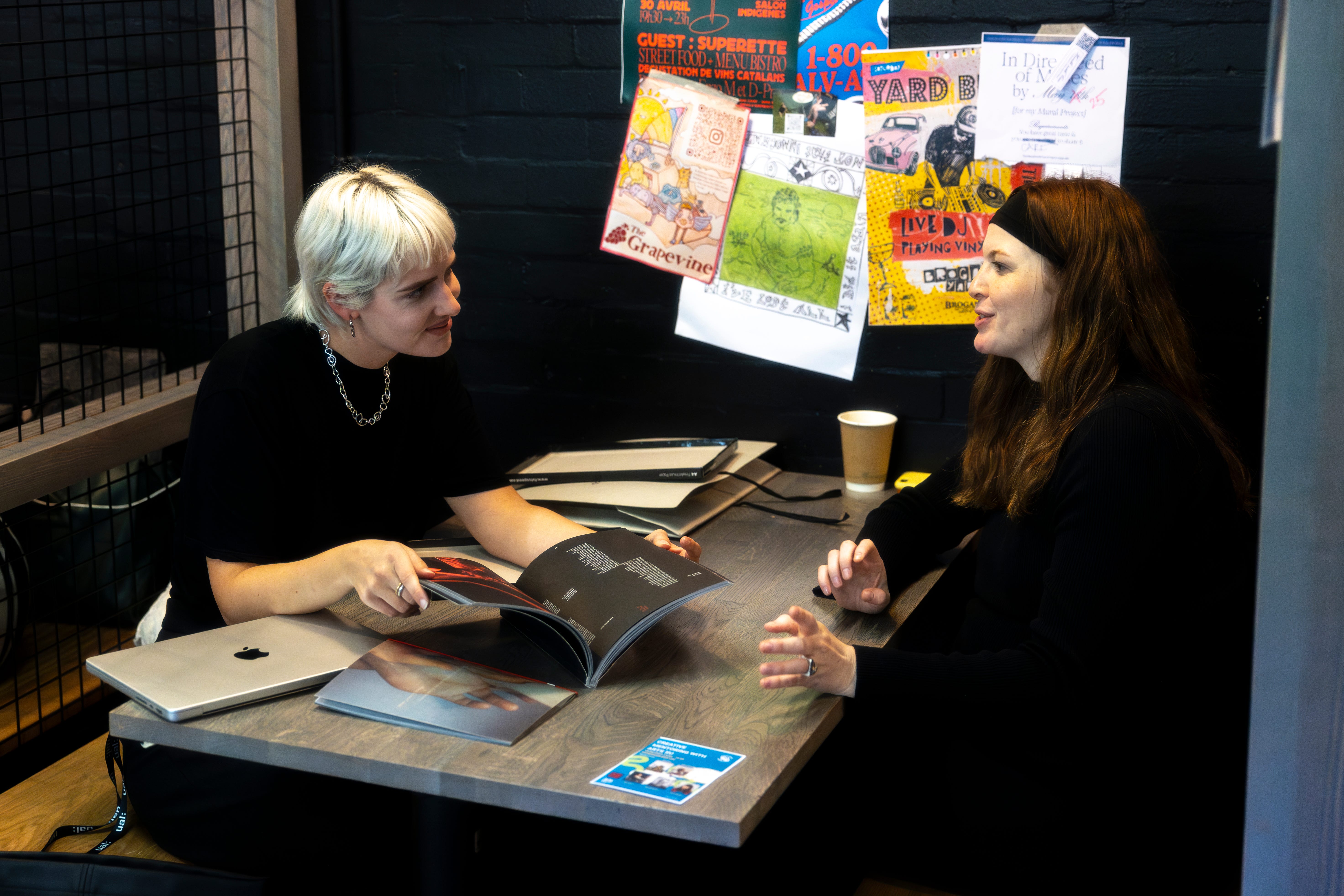
Image: Creative Mentoring session featuring Julia Howe. Mati Grancia © Arts SU
After the event it was fascinating to hear feedback from student Arts Programmer Evie Harman who worked and participated as a mentee and provided thoughtful reflections which we wanted to underscore through an evergreen resource. Coming together with Radhika Chaudhary- Arts SU Arts Programme student Designer to copy edit and design a zine which unpicks the role and importance of mentoring; considerations for both mentee and mentor and approaches to structured thinking about creative practice. Having left Arts SU in November 2025, but hearing that the zine was recently printed and distributed I felt it relevant to bring Evie and Radhika back together to chat about mentoring, accessibility and the zine.
Evie and Radhika, I recently volunteered to be a mentor as part of the One Million Mentor programme. The thinking behind this was to expand on my volunteer experience during a downtime in fulltime employment, to continue my work supporting young people to develop and lastly to commence a committed mentoring practice. I’ve dipped in and out of being a mentee and found all the conversations I’ve had incredibly useful, empowering and inspiring. I was wondering if you could chat a bit more about your experience with mentoring and / or being a mentee.
RC: My journey with mentoring started officially when I came to UAL in September 2024 for my Masters. But even before that when I was in India I was living with a senior from my undergrad university. Living with them I learnt a lot. It wasn’t official peer mentoring, but seeing how they work on their creative projects and doing pop up markets with them was a huge learning experience for me.
I learnt how to be more playful with my art to explore and experiment more. It really changed my perspective on illustration. I used to have a very perfectionist mindset and would get deeply anxious on the thought of creating something different. They were also the ones who introduced me to zine making. Now zine making has become a huge part of my practice.
At University I also got my Dyslexia diagnosis and that was a huge moment for me where I had to pause and rediscover what I knew about myself. This added a new layer to my practice. During this time my Professor and peers helped me a lot in my learning journey.
During my final months at Uni’ I started peer mentoring and helping new students get familiar with the campus supporting them through their academic journey. I feel throughout my own journey I have learnt the most through my seniors and peers. Sometimes Professors or tutors could be intimidating to talk to especially if you are new to the environment. Peer mentoring is a great alternative and also a way to learn from experiences of someone who has been through similar experiences.
Creative mentoring has been a great way of learning as someone who’s new to the creative industry in the UK. Meeting people from the industry and learning from them directly gave me a good idea of how to position myself as a creative in the UK.
EH: My mentoring journey started at age 14, when I was struggling with anxiety and attending school. My teacher connected me to an organisation called The Girls Network, and I was paired with a mentor to help me plan for my future. We would meet in a library once a month and this is where I was introduced to intersectional feminism, university degrees and the different career prospects creative people can consider. Whilst this wasn’t direct mental health support, the hope and inspiration my mentor gave me really supported me in more than a career sense. I suddenly had dreams I really wanted to work towards, and this gave me a drive to push through therapy, etc. I’ve stayed connected to The Girls Network ever since, helping to design their Ambassador Community for post-programme alumni, facilitating a speed-networking at No.10 Downing Street, and ‘Reverse Mentoring’ the Chief Executive of Programmes towards a more ‘Girl-Led’ leadership structure.
I used these skills and started running a feminist youth group for girls aged 5-15. I hosted sessions on confidence, friendship, campaigning, period poverty and more. In a way, I similarly viewed this role as being a mentor; my goal was to help them navigate girlhood with strength and to realise their potential. What they don’t realise, though, is just how much I learnt from them about trying things that scare me and building friendships.
If it wasn’t for my first mentor, I would never have made it to university, and for this I am really grateful. I am the first in my family to complete A-Levels, let alone a degree, and so this felt like a major milestone to cross. But what I didn’t realise is that it’s not just getting into university that’s difficult to access, but actually attending art school is very challenging as a working-class creative. To help me navigate these challenges, I applied for a mentoring programme with the Creative Mentor Network. My mentor was great and really helped me navigate and challenge the impostor syndrome and hopelessness I was feeling at Central Saint Martins. His words still stick with me today. Thanks to him, when a blank canvas feels overwhelming, I start with my worst idea and go from there and see what happens. When you throw multiple ideas at the wall and nothing sticks, you soon learn why, and this is a great starting point for creative block.
We’re now in 2026, and, despite the many recurring times I thought it was impossible, I have graduated! I’m navigating the quite daunting world of life post-graduation, and it is tough out there! Balancing my practice with full-time work has been a journey, and at times I have questioned my craft. When I feel like this, I return back to the speed networking event you hosted, Sophie, and I realise that careers are really topsy-turvy. Each person I met at your event had their own unique paths towards where they are now. As I try to define what this path looks like for me, I’m looking to my current mentor, a curator and writer that UAL’s Careers and Employability team has paired me with. She’s helped me to realise the potential of my practise, and the validity this holds even when I can only give it a limited amount of time. I’m learning to create without a university brief for the first time and having someone to share my ideas with helps this project feel a little less isolating.
What interests me most about mentoring is how it creates space for knowledge exchange with people I might otherwise have never met! As a mentee, I’ve learned to be vulnerable, to ask for help, and to try things that scare me. As a mentor, I’ve learned to listen, to examine my own positionality, and to empathise. It’s an ever-evolving practice, and one I hope to carry with me as I grow.
Data from 1MM on the role of mentoring.
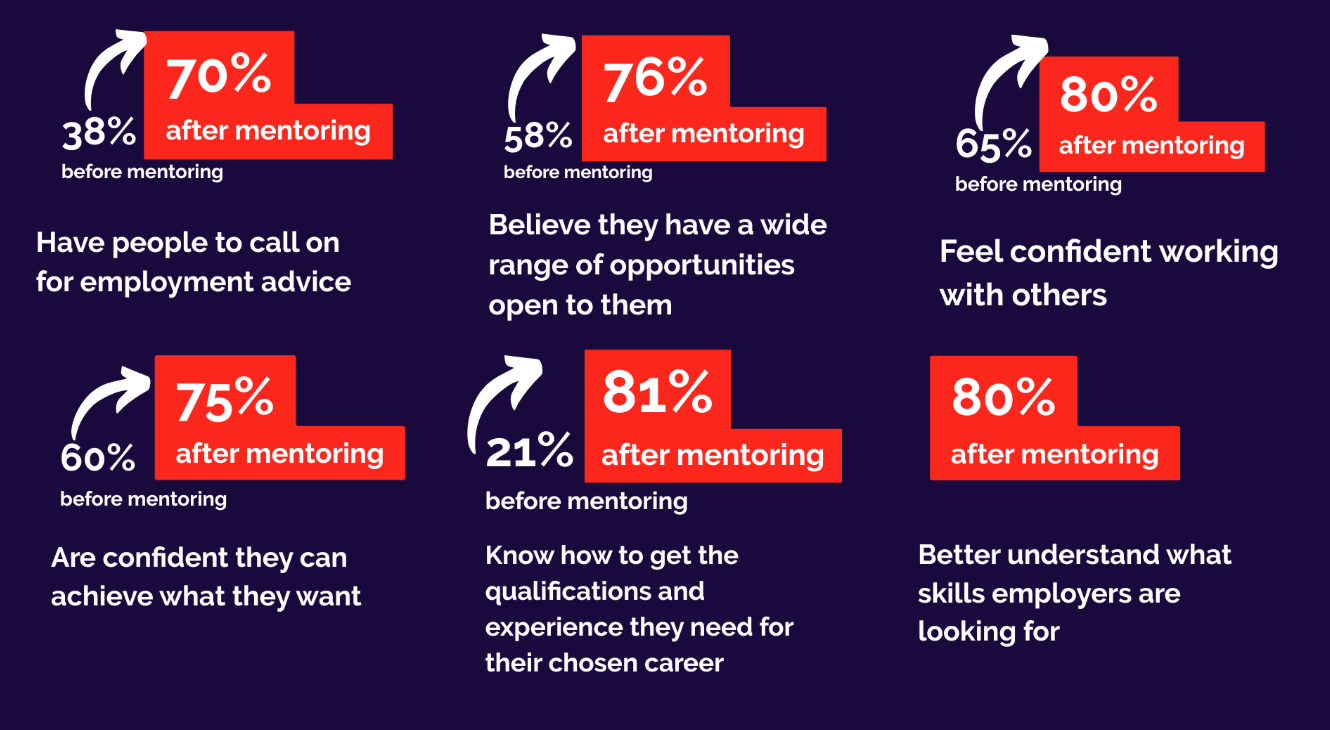
Source: https://onemillionmentors.org.uk/in-numbers/
SR: I programmed the Arts Programme’s first Creative Mentoring event at the Darkroom Bar, London College of Communication back in June last year. I invited 5 fantastic mentors which I hoped roughly represented the 6 core areas of study at UAL; Art, Design, Fashion, Creative Computing, Communication and Performing Arts. I wondered if you could share your thoughts on how best to host a mentoring event especially taking accessibility into consideration.
RC: Creative mentoring and talking about accessibility needs is so necessary. As a neurodiverse person myself it can be quite tricky to connect with people when you struggle to understand certain social norms and every networking opportunity feels quite superficial. It can be awkward and difficult. But it’s still a great way to meet people and make friends and some genuine connections.
I think it’s good to keep in mind that some people might be shy or think they are being “too much” because of how many questions they ask. (A quite common experience for Autistic individuals who have been told their behaviour isn’t acceptable.) so have a session that reassures mentees that it’s okay to be curious and ask questions. Also a flexible structure is ideal for someone with ADHD who might struggle to sit still for too long. So having access to stim toys or flexibility in terms of being able to move around. For learning disabilities such as dyslexia it’s helpful to have read scales in case there is a lot of text to read. It’s also helpful to provide written materials or flow of the workshop in the beginning so there aren’t surprises and everyone is familiar and feels safe in the surroundings. Bringing in different abilities; creatives who are established artists/ creative professionals is inspiring to see that we can be successful too. Getting advice from and learning from someone who has had similar experience is quite reassuring and motivating. And making sure where the session is happening it’s either on ground floor or has easy access to lift for anyone with physical disabilities. And for anyone with sensory needs for them to be wearing noise cancelling headphones or loop earbuds so they can focus better is always helpful. Also while introducing yourself as the host mentioning pronouns is helpful as it makes any trans or gender queer person feel safe enough to share their pronouns too.
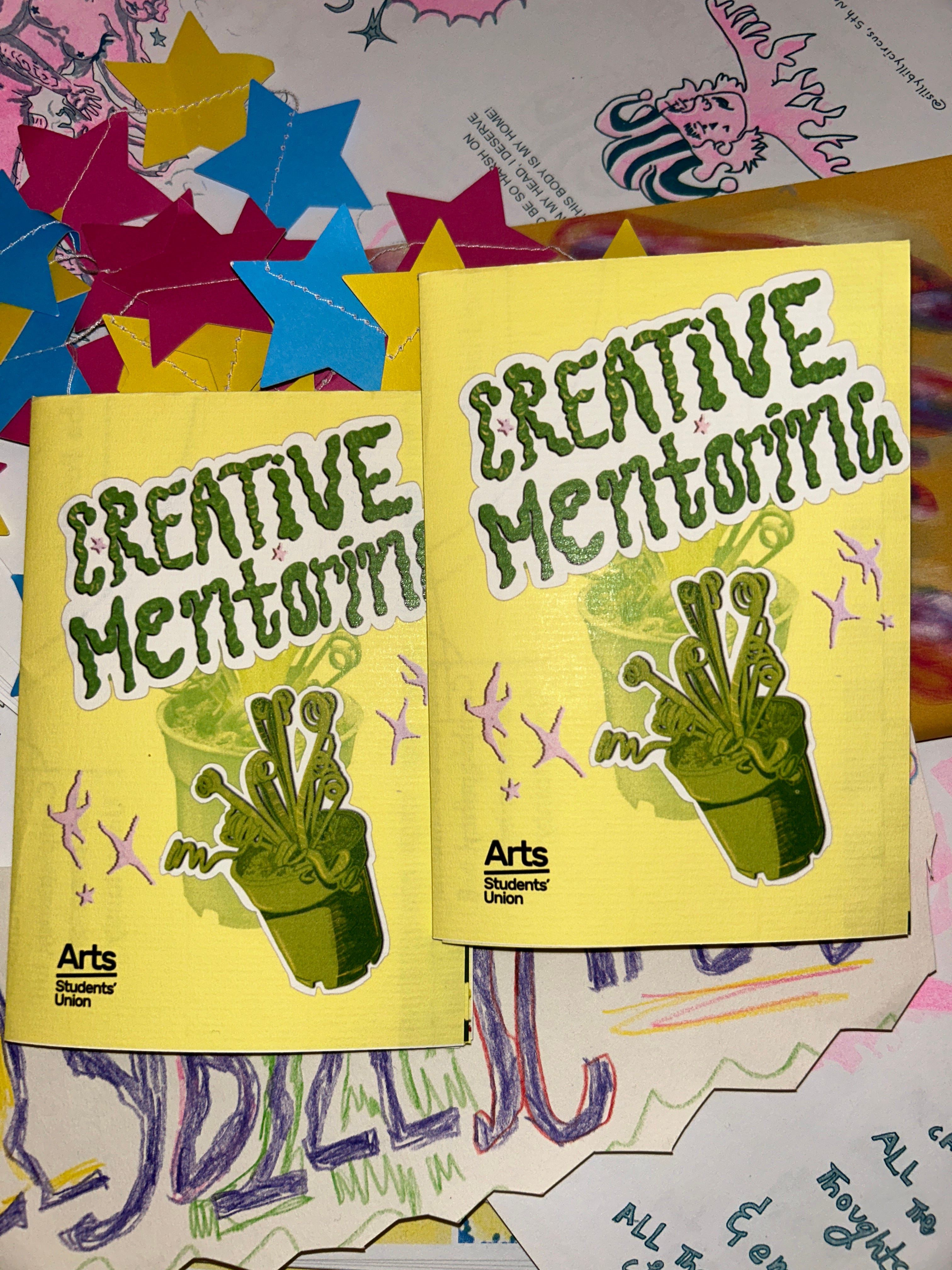
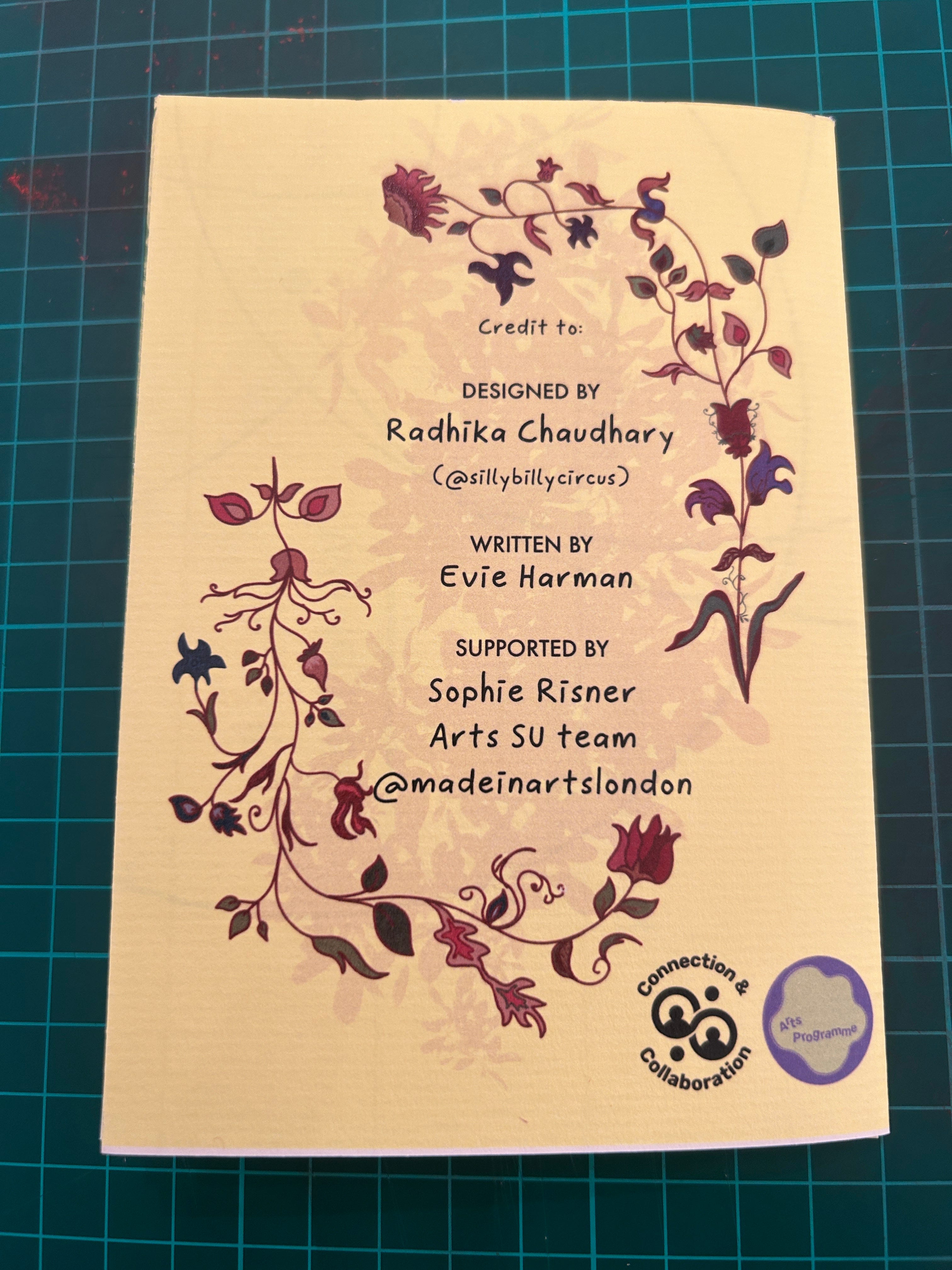
Image: Arts SU creative mentoring zine written by Evie Harman and designed by Radhika Chaudhary
EH: Mentoring and networking events often come with unspoken codes of conduct that can quickly become overwhelming. As someone with ADHD, I know how valuable industry connections are but building these relationships feels so daunting! There’s so much to navigate: Is the room too loud to focus? How do I start a conversation and stay on topic? Is there an expectation to perform a ‘professional’ version of myself?
And for people new to London’s creative scene, there’s an added layer of mystery. How should I dress? What do these acronyms mean? Will I relate to the people in the room? As someone from a working class background, I’ve had to learn these unwritten rules, and at times felt like an outsider for not relating to the people in the same room as me.
I think for me, the key is answering as many “what if” questions as possible upfront. Communicate who’ll be in the room, what to wear, what to bring. Then offer optional toolkits such as conversation prompts, time boxed sessions etc. I love opening with a game: find someone who shares your favourite biscuit. It pairs you with a peer, creates low-pressure conversation points throughout the event, and sets a friendly tone that prevents people from feeling they need to dive deep into their artistic practices immediately.
I also think it’s really useful to train mentors so that they feel confident in asking open questions, noticing when someone’s struggling to contribute and making space for contribution. If mentors are provided with inclusion training, they can ensure their insights are reached to more mentees that perhaps might otherwise face barriers in engaging.
With most community events, I also think it’s important to invite a small advisory panel from your attendee community to shape decisions on how the event runs. And to invite attendees to make choices on the event too, such as venue volume, use of music, lighting, whether to pair solo attendees with one another so no one is on their own etc.
What I really loved about your event, Sophie, is that you used The Darkroom to host your event, this didn’t feel to ‘formal’ and is already familiar to students and you introduced mentors in advance so people knew who they would be speaking and could prepare if they wanted to!
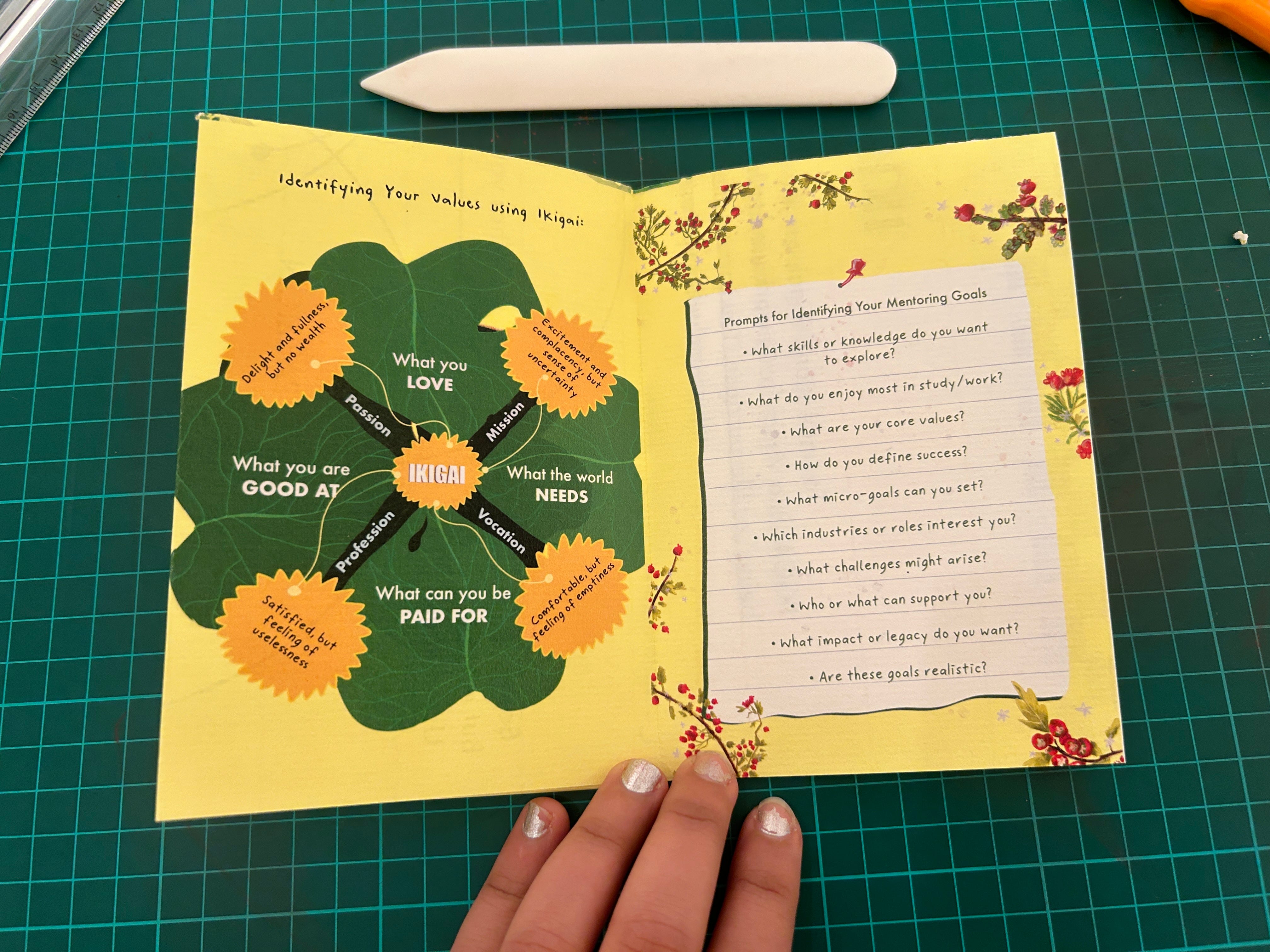
Image: Arts SU creative mentoring zine, written by Evie Harman and designed by Radhika Chaudhary
SR: Finally, from the feedback after the event and hearing more about how much you both cared about mentoring we managed to come together to create this brilliant Creative Mentoring resource, which Arts SU have now added to their resources online- can you explain a bit more about the ideas behind it and the design intentions.
RC: I went to Kew gardens just before I started working on this project with you and Evie. There I saw a plant (that’s on the front cover) that I found very fascinating and exuded a whimsical feeling. When I thought about the creative mentoring zine. I thought of mentoring like watering and taking care of a plant . So I thought of experimenting with botanical illustrations. To make learning fun and whimsical and not a zine that’s just text and overwhelming to read. Initially I only wanted to stick with 2 colours yellow and green. Both colours to me symbolised joy and calm. That’s what creative mentoring is right? It’s supposed to be fun to learn from one another but also to care for one another like a community, helping each other to grow.

And with the 8 fold zine, the front side of the zine had all the pages but I also wanted to use the back to add a little interactive element so after reading people can actually use the Ikigai diagram to understand their values and what they believe in better. To put the theory into practice. It also seemed like a good use of the back side of the paper.
EH: Radhika and I had already collaborated on Crit Kit, a zine for Crits Hub designed to provide a framework for compassionate Crits at UAL. We’d developed an approach together where we took our research and ideas on accessible and collaborative Crits and translated them into a pocket sized visual learning resources. Radhika is amazing at turning my words into engaging diagrams and visuals and I am so grateful we met through this project!
After your mentoring event, Sophie, I noticed that the event you hosted provided such an amazing opportunity, but many of the students there didn’t know how to make the most of this! Some were nervous approaching mentors. Others worried their practice wasn’t relevant to mentors outside of their subject focus. Most had never done this before (which is why the event was needed!) but it was this inexperience that created anxiety. It was a no brainer to apply Radhika and I’s collaborative way of working to create a new zine that welcomes people to mentoring.
For the zine, I researched different mentoring models and pulled from my own experiences, considering the limits and benefits of each mentoring style. I wanted to move away from industry jargon and the pressure some people might feel from starting their mentoring journey! I intentionally tried to connect this to values and goals, so that people knew how to show up authentically to their mentoring journey.
Mentoring to me is a practice and a learnable skill for both mentors and mentees that develops over time. Radhika’s visual language reflects this through plants and optimistic, bright colours. Like a plant, you need to remain dynamic when mentoring needing to grow and adapt with care to be successful.
Arts SU creative mentoring zine flick through, written by Evie Harman and designed by Radhika Chaudhary
Thank you Sophie and Evie for this incredible collaboration and interview! 💜
Thanks for interviewing us Sophie! 💗